National Mediation
Family Support

A measured path through family change
A complete view of how National Mediation helps families work through children's arrangements, financial questions, property, communication, and the practical realities of separation with care at every step.

When family life goes through change, the difficulty rarely arrives one piece at a time. A relationship ends. Routines shift. The home feels different. Money may suddenly become tighter. Children may sit between new schedules and new expectations, carrying feelings they do not always know how to express.
Even small conversations begin to feel weightier than they used to, because every topic seems to carry more meaning than before. For many people, this is the hardest part of separation or family conflict. The pressure is not only practical. It is the work of trying to act reasonably while still carrying hurt, frustration, worry, or exhaustion. It is the burden of having to make decisions even when communication has begun to break down.
National Mediation guides people through this in a more grounded way. It offers a quiet, structured environment in which families can discuss important matters without internal struggle becoming external conflict. The National Mediation Helpline also supports people who need a clearer starting point. It allows people to move from reaction to conversation, from uncertainty to clearer thinking. It does not take the sting out of family breakdown. It does not pretend everything can be solved easily. But it does create a process that is gentler to walk through, fairer in tone, and far less harmful than allowing conflict to grow on its own.
Family disputes are rarely about only the issue at the surface. A discussion about children may carry years of fear, frustration, or older tension. A disagreement about money can be threaded with deeper concerns about safety and the burden of starting again. A question about the family home can hold both practical need and a quiet emotional attachment. Mediation makes room for these layers while keeping the work practical and forward-looking.
National Mediation is for people who would prefer a more peaceful way ahead. It gives shape to challenging conversations. How it work Family Mediation UK Explained offers a helpful overview for people who want to understand the process more clearly. It keeps the focus on outcomes. It opens the room wide enough that each person can be heard without dialogue collapsing into blame or silence. Mediation opens a door for families willing to move forward at whatever pace they can.
National Mediation supports families who would like to resolve conflict in a more constructive way. It is for those who need help navigating difficult conversations, weighty decisions, and the emotional pressure that often accompanies separation or family fracture.
The service rests on a simple idea: it is better to work through family difficulty calmly and with a steady frame of mind than to repeat the same argument again and again. When people are left alone with conflict, the same points often come around. Nothing changes. Tension builds. Misunderstandings grow. Mediation alters the tone of that process. The Family Mediation Voucher Scheme UK can also help some families access support more easily. It creates an environment in which people can be more open, attentive, and considered, free of the urgency and stakes of a head-on confrontation. This becomes especially valuable when communication has worsened, or when direct conversation has become difficult to hold without breaking down.
Mediation is not about deciding who behaved better or worse. It is not about getting one person to give in. It is a balanced, practical approach focused on the future rather than the disagreement.
Families seek mediation for many different reasons. Some are working through arrangements for children. Some need help with money, property, or debts after separation. Others are simply trying to understand what the next step might look like. Some know that the current situation is not working but are unclear about how to move on. That is precisely what mediation is well suited to. It turns uncertainty into a process. It brings clarity to the next step. It offers people a way to begin again with more structure and less strain.
National Mediation always begins with the human side of things. Family conflict is emotional and personal and often a tangled mix of practical and emotional concerns. A good process must reflect that.
Contact Us if you want to take the next step in a calmer and more informed way. It needs to be solid enough to be useful and flexible enough to fit real life. Mediation sits at the centre of that balance.

Each area below is described in more detail throughout this page. Mediation usually involves more than one of these — they are seldom truly separate, and they are addressed together where helpful.

Family mediation is a guided form of conversation that helps people resolve disagreements rather than fight them out. It is most often used when families are separating, divorcing, or facing conflict over the practical realities of daily life.
At its heart, mediation helps people discuss what matters most in a more structured and constructive way. The conversation is supported by a mediator, who keeps the discussion balanced and focused. The mediator does not take sides. They do not make decisions for the family. Instead, they help each person explore options and move towards realistic agreements.
This is important because family conflict often gets caught in heightened emotion. People circle the same ground. They interrupt one another. They avoid certain topics in case they spark another argument. The atmosphere of mediation is different. It slows things down. It gives each person room to speak. It keeps the conversation moving towards practical outcomes.
Family mediation can address many areas, including arrangements for children, financial conversations, property and housing, concerns about debt and pensions, divorce and separation, and difficulties with communication after a relationship has ended. Child Arrangements UK Explained gives extra context for families trying to understand how these decisions are approached. Mediation allows the family to take a wider view rather than treating each issue in isolation. That mirrors how family life actually works decisions about children affect where people live, financial decisions shape security, and one set of choices is rarely separate from another.
Part of what makes mediation valuable is that families remain in control of the conversation. They are not passing everything to a court process or letting the conflict carry on unsupported. They shape the outcome themselves. That tends to produce arrangements that feel more practical and that work better in real life.
Mediation is also flexible. It can take different forms depending on what suits each family. Some can sit in the same room and talk. Some need a more spaced-out approach. Some are willing to address several issues at once. Others prefer to begin with one and move forwards from there. Mediation can adapt to all of these. For many families, it becomes a turning point not a moment in which everything is suddenly easier, but the moment a path becomes visible where, before, there appeared to be none.

Why do families choose mediation? Often because they recognise that not every conversation can be resolved without help. Time spent in unresolved conflict is rarely time well spent. They do not wish to spread the strain of difficulty across every part of life. They are looking for a more sensible, practical way of moving forward.
One of the main reasons people give for choosing mediation is that it eases the emotional pressure that surrounds hard conversations. People say things they do not mean when they are hurt. They defend too quickly. They feel unheard. A solvable disagreement turns into a recurring argument. Mediation interrupts that pattern.
Another reason is that mediation keeps families inside the process. This matters because most families want some control over what happens next. They want their situation to be understood. They want arrangements that make sense day to day. Mediation gives them that opportunity. It allows them to be part of decisions rather than read about them after the fact.
Mediation is also chosen because it feels less formal and more private than court. Family matters are personal. They can feel exposing, especially when emotions are already high. Mediation provides a safer setting in which to speak honestly without each conversation becoming the start of a wider battle.
Flexibility is another draw. Real life is complicated. Parents work different hours. Some live elsewhere. Children have routines. Child Access Mediation UK Explained can help families understand one part of how these arrangements are approached. Money may be tight. Some forms of communication may simply not be possible at this moment. Mediation works with these realities rather than asking families to fit into a rigid box.
Many people are also drawn to mediation because it helps protect children from a tense atmosphere. Even when children are not directly part of the conflict, they sense it when adults are struggling. Mediation keeps the focus on what children need and helps adults make decisions that lift some of that pressure away.
Mediation is, in the end, about finding a workable solution that reduces strain and helps build a steadier future. That is why it remains such a meaningful choice for so many families.

A MIAM is usually the first step in mediation. The letters stand for Mediation Information and Assessment Meeting. The name is more formal than the meeting itself.
Its purpose is straightforward. It is an introductory conversation used to explain how mediation works and to consider whether the process is likely to be a good fit for the situation at hand.
For people uncertain about mediation, the MIAM can be reassuring. It is not a commitment to a full process. It is an opportunity to talk through options, walk through the situation, and ask questions. That can lift some of the uncertainty that often accompanies family difficulty.
During a MIAM, the mediator usually finds out about the issues, the family background, and any concerns that might affect whether mediation is suitable. This may include questions related to children, money, or communication challenges, alongside any wider aspects of the family dynamic.
The meeting also gives the attendee space to share what they hope to work through. That matters because many people arrive carrying a great deal — frustration, worry, protectiveness, or exhaustion with the way things are. The MIAM allows for these feelings to be raised in a safe and steady environment.
It is also useful because it gives people a greater sense of agency. Mediation can feel unfamiliar at first, and many people simply do not know what to expect. Once the process is explained, it usually feels far less daunting. If mediation appears appropriate, next steps can be agreed. If it is not the right fit, that can be identified early. That early assessment matters because it ensures the process is being used well and in a healthy way.
National Mediation treats the MIAM as a meaningful first port of call. It helps families begin from clarity rather than ambiguity.

Family conflict is sensitive in the calmest of times, but when children are involved it becomes more delicate still. Adults may be navigating hurt, disappointment, or frustration, and at the same time the children continue to need stability. They need predictable routines. They need to feel safe. They need to understand what is happening without being placed in the middle.
Mediation helps parents keep that focus clear. When separation means parenting from different households, parents need to discuss where children will live, how time will be shared, and what the day-to-day routine looks like. These decisions touch a child's life every single day — mornings before school, weekends, holidays, handovers, and the quiet sense of security that children rely on. Mediation provides a structured way of working through those arrangements with less stress.
Child-inclusive practice rests on the idea that children's voices should also be heard. There may be moments when giving weight to a child's perspective is appropriate, although this is usually approached carefully and with guidance. It does not mean placing the responsibility for any decision on the child. It means making space for their feelings and experience to be considered.
Child maintenance is another area that often comes into focus during separation. Communication may be strained, or there may be disagreement over responsibilities. Mediation brings clarity to the table and offers parents a place to move towards arrangements that genuinely support a child's needs.
Family dynamics can also shift in ways that affect grandparents. In many families, grandparents are deeply important in a child's life. Where access has been restricted or disrupted, mediation can support the search for ways those relationships might continue in a manner that is healthy for the child.
Allegations connected to parental alienation can be particularly painful. Mediation allows situations like these to be looked at carefully, keeping the child's wellbeing at the centre and recognising that lasting connection with both parents — where appropriate — usually serves a child best.
Parenting plans are often a positive outcome of this work. A clear parenting plan can ease daily life considerably. It can include schedules, communication styles, decisions made jointly between parents, holidays, handovers, and shared expectations. That structure tends to lead to fewer misunderstandings later and a steadier sense of stability for the children.
Mediation involving children is not about deciding which parent is right. It is about helping adults reach arrangements that serve a child's best interests and reduce conflict around them. It is a responsibility that deserves care, and mediation is well suited to it.

One of the most useful outcomes of mediation, for many families, is a parenting plan. The phrase can sound technical, but the idea is simple. It is a clear, practical, written agreement that describes how parenting will be handled after separation or change.
A parenting plan helps answer the everyday questions that otherwise become repeating arguments. When will handovers happen? How will holidays be shared? Who will make decisions about education or health? How will parents communicate? What happens if plans need to change? When these questions remain unanswered, the result is steady low-level stress.
A good parenting plan is more than a list of arrangements. It helps create stability. Children benefit most when they know what to expect. Parents benefit when there is less room for confusion or disagreement. Having a shared point of reference helps everyone in the family.
This is where mediation is especially helpful, because it creates the space in which a parenting plan that genuinely reflects family life can be shaped. It is not imposed from outside. It is built through conversation and adjusted to be realistic, which is what makes it more likely to actually work.
A parenting plan also reduces the emotional weight of revisiting the same issues again and again. Fewer ambiguities mean fewer flashpoints. That can ease pressure significantly and make communication more workable. For many families, this is one of the most useful elements of mediation — something tangible and practical that helps guide what comes next, rather than only one passing conversation.

Child maintenance is one of those areas that can feel emotionally charged even when the underlying question seems straightforward. It touches responsibility, fairness, and the financial realities of raising children after separation.
Speaking about child maintenance openly and constructively is difficult when communication is already strained. One person may feel they are paying too much. Another may feel the support is not enough. Sometimes the difficulty is not the figure itself but the conversation around it. This is where mediation makes a difference.
Mediation gives these conversations a calmer setting. It keeps both people focused on what supports the child rather than allowing the discussion to drift into wider disagreements about the relationship itself. That distinction matters. Child maintenance should be guided by the welfare of the child, not used as part of a broader argument.
Clarity reduces stress for parents. It helps them know what is expected, which spares everyone from revisiting the same uncertainty repeatedly. It can lead to more secure, more predictable arrangements for children. Financial conversations will rarely feel weightless, but mediation tends to lower the temperature and bring attention back to what genuinely matters.
Mediation is, in the end, about finding a workable solution that reduces strain and helps build a steadier future — not perfection, not instant agreement, but progress that feels human and reachable.

Money is often the most stressful part of a family breakdown. It shapes where people live, how they feel from day to day, and how hopeful they are about the future. When emotions are already high, financial conversations can become tense quickly.
Financial mediation creates a setting in which these conversations can be held more calmly and in a more structured way. The discussion may concern income, savings, debts taken on during the relationship, monthly outgoings, or longer-term planning. It may include working out shared responsibilities or developing a sound financial picture for life after separation. These are difficult conversations, but they are necessary ones.
Mediation has a real advantage when it comes to financial matters because it keeps the focus on what is practical. It allows people to step away from going around in circles about principles and fairness, and to look instead at what is realistic. What is sustainable? What will work in everyday life? What allows both people to move forward without unnecessary strain?
This is especially relevant when money is tight. Financial pressure can make people defensive and frightened. They may worry about the future, about housing, or about basic costs. Mediation gives those concerns space without allowing them to take over the entire process.
It also helps when one issue affects many others. A financial disagreement may touch housing, children's arrangements, or planning for life after separation. Mediation helps connect those threads so that a fuller view is possible rather than each issue being treated in isolation.
National Mediation approaches financial matters with care and realism. The aim is not to oversimplify. It is to help people navigate a complex area with greater clarity and less effort.

Debt can sit heavily on a family, especially when separation or conflict has already made life feel uncertain. It influences everyday life, decision-making, and the sense of control people feel over their future.
Debt mediation gives people a way to discuss these matters in a structured fashion. Debt tends to bring strong feelings into family disagreements. Some people feel afraid, others angry, others simply overwhelmed. Disagreements often arise about how to respond, who should carry which burden, and how arrangements should be made. Mediation helps focus the conversation on the practical aspects of the debt and possible ways forward.
Conversations like this can be particularly valuable where people are trying to distinguish what is shared, what is individual, and what is realistically manageable. The aim is not to pretend the issue is smaller than it is. It is to address it without making it worse.
Debts often affect other parts of a family settlement. They can shape decisions about whether to keep the home, monthly budgeting, and the timing of moving forward after separation. That is why addressing them within a wider mediation process is so useful — they can be considered alongside everything else rather than left to apply quiet pressure from below.
A calm conversation can go a long way here. With structure and steadiness, it is easier to move from feeling stuck to thinking clearly about what comes next.

The family home often carries both emotional and financial weight. It can represent stability, memory, safety, and many years of shared experience. As a result, when property needs to be divided, the conversation can grow tense quickly.
Property mediation provides a more measured way of approaching this. It can include whether or not to sell the home, whether one person stays, how to treat its value, and the financial arrangements that go with it. These are practical questions, but they are also human ones. Mediation makes room for both.
For one person, the priority may be stability for the children. For another, it may be the chance to begin again. One may feel deeply connected to the home itself. One may be under financial strain. All of these are valid, real concerns. Mediation helps people move through them without the conversation collapsing into a single sticking point.
One of the benefits of mediation here is that it encourages more deliberate thinking. It allows people to consider what is fair, what is achievable, and what will let both parties move on. That often leads to outcomes that feel more manageable and less damaging.
Property questions can hold up everything else in a settlement when left unresolved. Mediation helps lift that uncertainty so families can move into the next chapter with a clearer view.

Pensions can be a complicated area within a family settlement. They are often technically complex and have effects that play out over many years. This makes them particularly sensitive during separation or divorce.
Mediation helps bring clarity to discussions about pensions. The subject itself is rarely simple, and mediation does not try to make it so. What it does is allow the conversation to be held in a clearer, more structured manner so that important questions are not left to chance or guesswork.
For many families, pensions are part of a wider financial picture. They can influence long-term security, retirement planning, and the sense of fairness after a relationship has ended. Mediation gives space for these questions to be considered with care rather than rushed through.
This is particularly helpful when people are already under strain over housing, childcare, or debt. Pensions may not be the first thing anyone wants to discuss, but they can be a meaningful part of the overall settlement. A calm and patient approach helps. Mediation provides the time and structure to think about the longer view rather than make hurried decisions in difficult moments.

Divorce is much more than a legal process. It is a major life change. It affects routines, home life, money, and the emotional atmosphere within a family. It can also leave a great deal of uncertainty about what comes next.
Divorce mediation provides a more constructive way of working through the practical matters that arise during and after separation. These may include arrangements for children, finances, property, or communication between former partners. Mediation allows them to be considered as part of one wider conversation rather than each issue being handled separately and in isolation.
That is helpful, because divorce-related issues are usually interconnected. A property decision may shape financial planning. A financial decision may shape where children live. A communication breakdown can disrupt almost everything else. Mediation keeps these connections visible, so the whole process feels more integrated and grounded.
Divorce mediation also helps relieve emotional pressure. The end of a relationship often comes with grief alongside conflict. When every conversation feels weighed down, sensible decisions become harder to make. Mediation creates a quieter environment in which discussions can continue more steadily. It does not mean emotions disappear. It means there is space to process them more thoughtfully — and that often leads to better conversations and better outcomes.

Family difficulty arrives in real life — at the busiest, most demanding moments. People may live far apart. Work schedules may make meeting times difficult. They may be caring for children or managing health concerns. Or they may simply not be ready to sit in the same room. Mediation needs to work with these realities, not around them.
This is where online mediation becomes useful. Online mediation allows people to take part from a place where they feel more comfortable. That tends to ease the strain of travel and makes the process easier to fit into daily life. For some, it feels less daunting because the surroundings are familiar.
Shuttle mediation is another flexible option. In this approach, the participants are not in the same room. The mediator moves between them, carrying the conversation. This can be particularly helpful where direct contact is too overwhelming or where emotions are simply too raw for a face-to-face exchange.
Both options matter, because they allow mediation to take place in situations where a more formal meeting would not be straightforward. They reflect a key principle of the process — that the format should adapt to the people, not the other way around. That flexibility can be the difference between no progress and real progress.

Cost is often one of the first concerns people raise when considering mediation. That is understandable. Family change frequently coincides with financial strain, and the idea of an additional expense can feel heavy.
In some situations, legal aid for mediation may be available. This can help open the process up to those who qualify. In some family cases, particularly those involving children, voucher support may also be available. Each of these can lighten the financial side of getting started, helping families take a first step without cost concerns standing in the way.
What this means is that families who feel uncertain about the financial implications of seeking help do not need to be discouraged from exploring options. Mediation works best when started early, before issues become more entangled. Awareness of the support that may be available can make that first step feel reachable.
Eligibility depends on individual circumstances, but the important thing is that families know support may exist. Knowing that, in itself, can ease some of the pressure surrounding the decision to begin.

Court has its place, but it is often not the most appropriate first step for families in conflict. It can be formal, slow, costly, and stressful. It tends to position people on opposite sides, which can make collaboration harder. That places considerable strain on families already struggling to find common ground.
Mediation offers a different experience. It is more collaborative. It centres on solving things, not breaking them apart. It allows people to remain involved in the decisions that affect their lives. That involvement usually leads to settlements that feel more practical and easier to live with.
Another advantage is flexibility. Mediation is adaptable by nature. It can begin by addressing one issue and move on to others later. It can take place online or in person, depending on what works. It can respond to the rhythm of what a family needs rather than fitting everyone into a single legal format.
Mediation is often gentler on continuing relationships too. Parents may need to keep communicating. Wider family ties — including grandparents — may still want to remain part of children's lives. Mediation preserves enough respect and structure for those connections to continue more easily.
This does not mean court is never appropriate. Sometimes it is necessary. But for many families, mediation offers a more human, more life-shaped path forward.
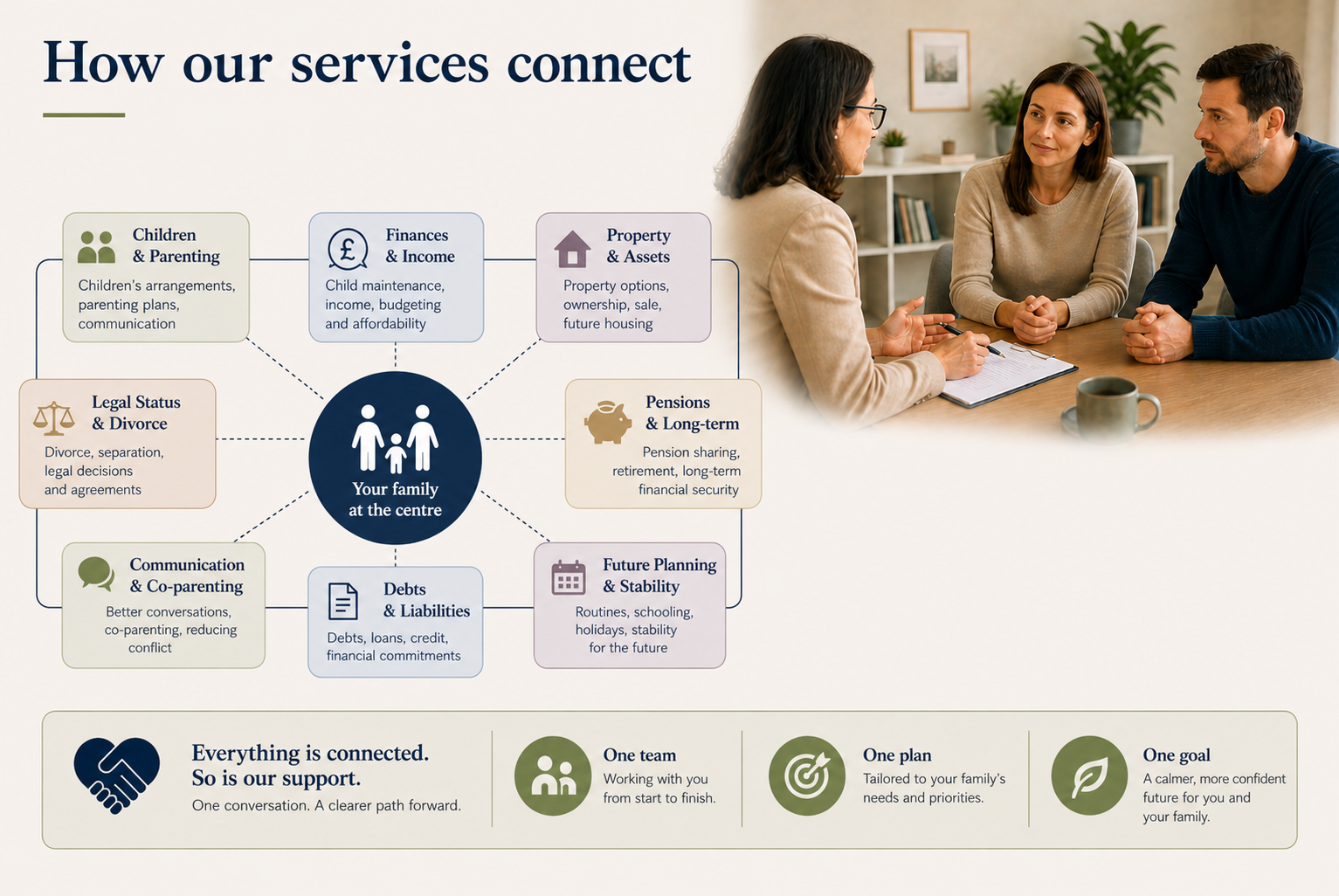
One of the most important things about families is that issues are usually linked. A children-related disagreement can carry a financial dimension. A financial issue may relate to property. Divorce influences communication, parenting, and future planning all at the same time. National Mediation recognises this reality.
For that reason, our services are not treated as standalone components. They are designed as part of a connected continuum. A family might begin with a MIAM. They may then work through arrangements for children, finances, property, or communication. They may prefer to use online or shuttle mediation, depending on what feels most workable. The wider context can also include divorce-related planning, parenting plans, child maintenance, and pension considerations.
This joined-up approach matters because families experience separation and conflict as a whole, not as a series of separate categories. One issue is rarely an island. Each part affects the others. A process that respects that, and helps people move through it on a steadier course, is more likely to produce real and lasting progress.
At National Mediation, the goal is to make that journey feel less fragmented. Families are already carrying enough. The process itself should hold things together, not pull them further apart.
It provides a structured space for working through family difficulties with care, rather than repeating the same disagreements without progress. It supports separation, parenting, finances, property, and broader communication issues.
No. Mediation can support arrangements for children, financial questions, property concerns, grandparent contact, and wider family communication issues.
A MIAM is the first meeting where the mediation process is explained and the situation is gently assessed. It allows everyone involved to understand whether mediation is suitable for their particular circumstances.
Yes. It is commonly used for child arrangements, child maintenance, parenting plans, and other matters that affect children's day-to-day lives.
Yes. Mediation can support conversations about debts, pensions, the family home, and other financial matters that arise during or after separation.
Online mediation and shuttle mediation are alternative formats that allow people to take part without needing to share the same physical space.
Mediation is generally treated as a private process, designed to allow open and honest conversation between the people taking part.
No process can guarantee consensus, but mediation gives families a constructive way to work towards practical outcomes, even where complete agreement is not possible at first.
In some situations, yes. It depends on individual circumstances and eligibility, but financial support for mediation can be available for those who qualify.
Mediation provides a less adversarial, more flexible environment, which can be particularly helpful where the family would prefer to keep more control over the outcome.
Family conflict can leave people exhausted, uncertain, and emotionally stretched. Even simple decisions can begin to feel weighty. It can affect sleep, work, parenting, and peace of mind. It can leave a quiet sense of unease about the future.
National Mediation offers a way to begin lifting that pressure. It provides a calm, structured way of facing the practical realities of family change. The About Us page gives a fuller picture of the approach behind that support. It allows people to discuss children, money, property, and separation more openly and safely. It supports better communication where dialogue has broken down. It offers flexibility when direct meetings are difficult. It encourages families to prioritise what truly matters and to act in ways that feel less overwhelming.
This does not mean pretending the work is easy. It does not deny the strength of feeling involved. But it does mean that families can do more than simply get through the difficulty. They can find a better way to respond one that helps them carry their children through hard moments and build something steadier on the other side.
For parents, that may mean clearer routines and less daily friction. For children, it may mean greater stability and less tension around them. For individuals, it may mean less uncertainty and more sense of control over what comes next. For families as a whole, it can mean something more respectful and more achievable. That is the quiet strength of mediation. Not perfection. Not instant agreement. Progress that is humane, considered, and reachable. National Mediation is here to support that journey, gently and one step at a time.